


Morning kings. With the Monday holiday we will be doing a Wednesday/Friday combo this week.
Before you log on to get into the full swing of a corporate Wednesday, we need to talk about what is going on in markets and what is likely coming next.
Stocks (many we highlighted) are continuing their god pump.
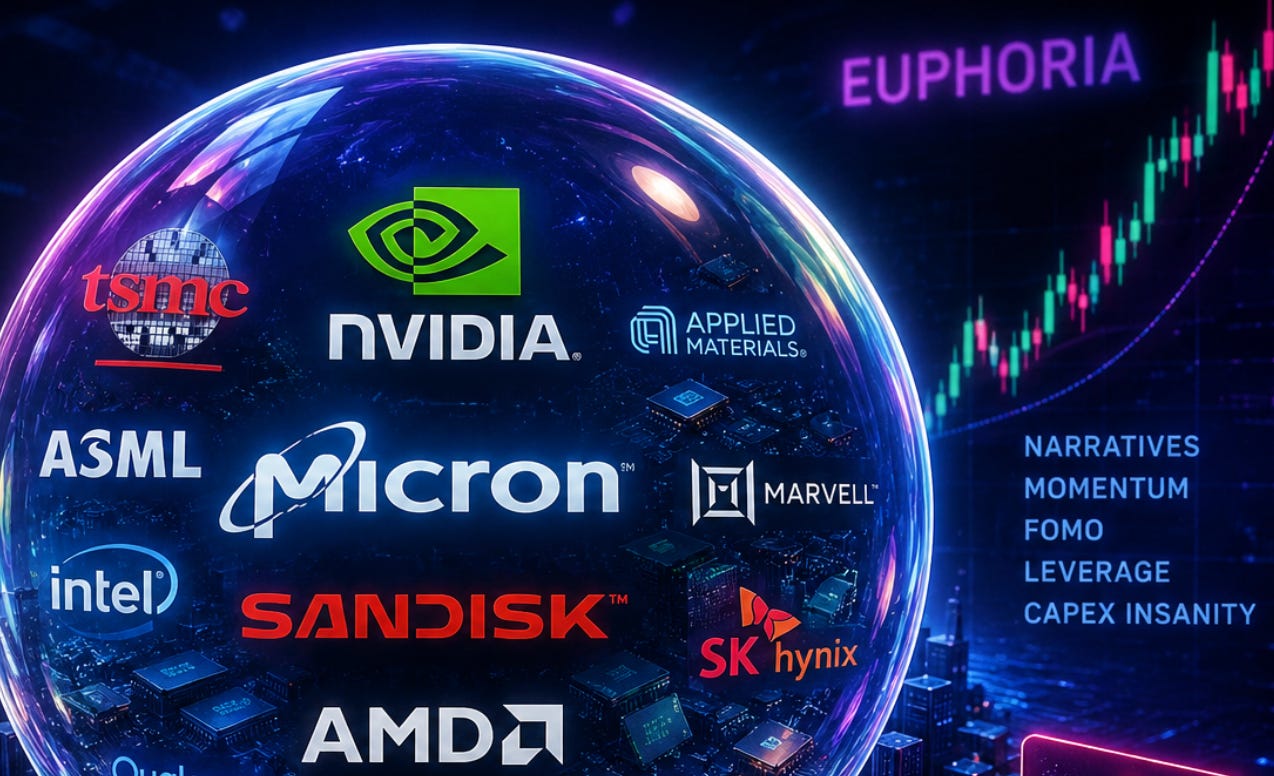
The word “bubble” gets thrown around constantly in markets. Today it’s AI, semiconductors and anything remotely tied to exponential technology.
Four centuries ago, it was tulips. In 1630s Holland, rare tulip bulbs became objects of outright speculation. Prices exploded to absurd levels. Contracts traded hands. Fortunes were made quickly. Fortunes disappeared even quicker.
One bulb could allegedly cost more than a house.
Then, almost overnight, confidence cracked and the entire thing imploded.
The lesson people take from tulips is simple. Bubbles are irrational and they end badly. The lesson investors often miss (and the entire reason for this post today) is more uncomfortable.
Some of the biggest money in history was made riding the mania before the music stopped.
Every generation thinks its bubble is different. In the late 90s, investors slapped billion-dollar valuations on companies with no profits and barely functioning websites. In 2021, degens bought JPEG monkeys and dog coins like civilization depended on it.
Today, the debate centers on AI, semiconductors, and whether we’re witnessing another historic speculative blowoff. The problem with bubbles is not that they’re hard to identify. The problem is that markets can stay euphoric and incredibly profitable (as we have seen) far longer than skeptics like Michael Burry expect.
The S&P 500 and Nasdaq just closed at new all-time highs. AI names that I highlighted over the last few weeks like AMD 0.00%↑ and MU 0.00%↑ continue to soar higher and higher. Semis now make up something like 18% of the S&P.
Our paid subs are printing. Retail thinks they are the smartest people in the room. People are jolly.
But it does beg the question: how is this all going to play out? Is a violent reversal on the horizon? I did some digging this morning and found an interesting market on Polymarket: AI Bubble Burst By…?
This market has the following conditions and a 21% chance it plays out by December 31st (3 need to hit):
NVIDIA Corporation (NVDA) closing stock price is down 50% from its all-time high
iShares PHLX Semiconductor ETF (SOXX) closing stock price is down 40% from its all-time high
OpenAI, Inc. or Anthropic PBC declares bankruptcy
OpenAI, Inc. is acquired
H100 rental price falls to $1.00 or lower for five consecutive days, as shown on the SiliconData Silicon Index
Major AI Hardware Supplier Collapse: Taiwan Semiconductor Manufacturing Company Limited (TSM), ASML Holding N.V. (ASML), Broadcom Inc. (AVGO), Arista Networks, Inc. (ANET), or Super Micro Computer, Inc. (SMCI), closing stock price is down 50% from its all-time high.

Pretty interesting. The market clearly does not think there is a high chance of these things happening. Will be good to monitor this data point moving forward.
Today we are going to discuss the following:
Are we actually in a bubble?
The #1 mistake people make during market bubbles (how to avoid)
The ways to trade euphoria and hype so you do not lose
Maybe this is a late stage speculative blowoff and a brutal unwind is closer than most people realize.
Or maybe we are simply in the middle innings of a genuine technological revolution that continues dragging equities, semiconductors, crypto, and AI infrastructure substantially higher with no regard for sidelined betas and soyboys.
Hopefully it is obvious to all of our readers why I have stressed for years now that you need to acquire assets at a rapid pace. People who are sidelined are missing out on profits and a massive class change that is playing out before our eyes. Owning a piece of this “bubble” is now table stakes.
Millionaires are being minted every hour in this market and people are achieving upward mobility as a result.
Tough part is knowing when to step away from the table before you lose everything.
“I stand by my analysis. I am not claiming Nvidia is Enron. It is clearly Cisco.”
—Michael Burry