


Morning guys.
Important one today.
In case you missed the biggest story in markets in the last 48 hours, Citrini (an independent, top-ranked financial research firm on Substack founded by James van Geelen) dropped a bomb this weekend that has Wall Street rattled.
The post highlighted a future scenario where AI adoption materially alters labor, payments, and capital flows across the economy.
The mania ramped up with additional headlines adding to the panic:
Hundreds of billions of dollars were wiped from the US stock market
IBM 0.00%↑ traded sharply lower after Anthropic launched another AI tool to streamline COBOL code modernization
Credit Cards Companies, Software, and Tech were bleeding hard yesterday, American Express AXP 0.00%↑ DoorDash DASH 0.00%↑ and ServiceNow NOW 0.00%↑ had notable dumps
Towards the end of the day yesterday The Kobeissi Letter answered with a take of their own where they deviated from some of the read from Citrini
The piece that Citrini released (that went MEGA viral) doesn’t rely on pure catastrophe or ridiculous science fiction. It just kind of lays out a believable scenario where things mostly keep working and the system still ends up breaking by about 2028.
AI keeps improving. It gets cheaper. Companies adopt it quickly. Human labor is replaced faster than new demand can form.
Productivity rises. Profits look fine. Output remains strong.
Underneath that though, the consumer economy starts to thin out pretty rapidly (one of the dynamics that they believe people might be underestimating). Machines and AI agents don’t earn wages. They can’t buy homes or penthouses. They don’t spend discretionary income and they don’t take on debt (yet).
As white collar jobs continue to disappear, income will fall. Rocket Science I know.
Spending will then contract and companies will invariably respond by cutting costs and automating even further.
The loop, Citrini says, feeds on itself. Efficiency goes up. Demand weakens and then circulation slows.
In that bleak environment, the usual signals stop telling us the truth. GDP can grow while the economy underneath it continues to weaken and markets can move higher even as consumer demand erodes. The risk in that environment isn’t necessarily a sudden collapse it’s a stretch where everything looks stable right up until confidence breaks (which is kind of how it’s felt for awhile).
Whether this exact scenario plays out or not, the takeaway is hard to ignore and it aligns with many of the posts we have done on the future of tech, AI, and markets in Arb Letter.
Understand this.
An economy built on human demand will behave very differently once humans are no longer doing most of the producing. And that is a reality that even the strongest critics of the Citrini piece have to concede is beginning to happen.
How many people actually understand this shift? It would appear not many. Check out the graphic below shared by @damianplayer on X.
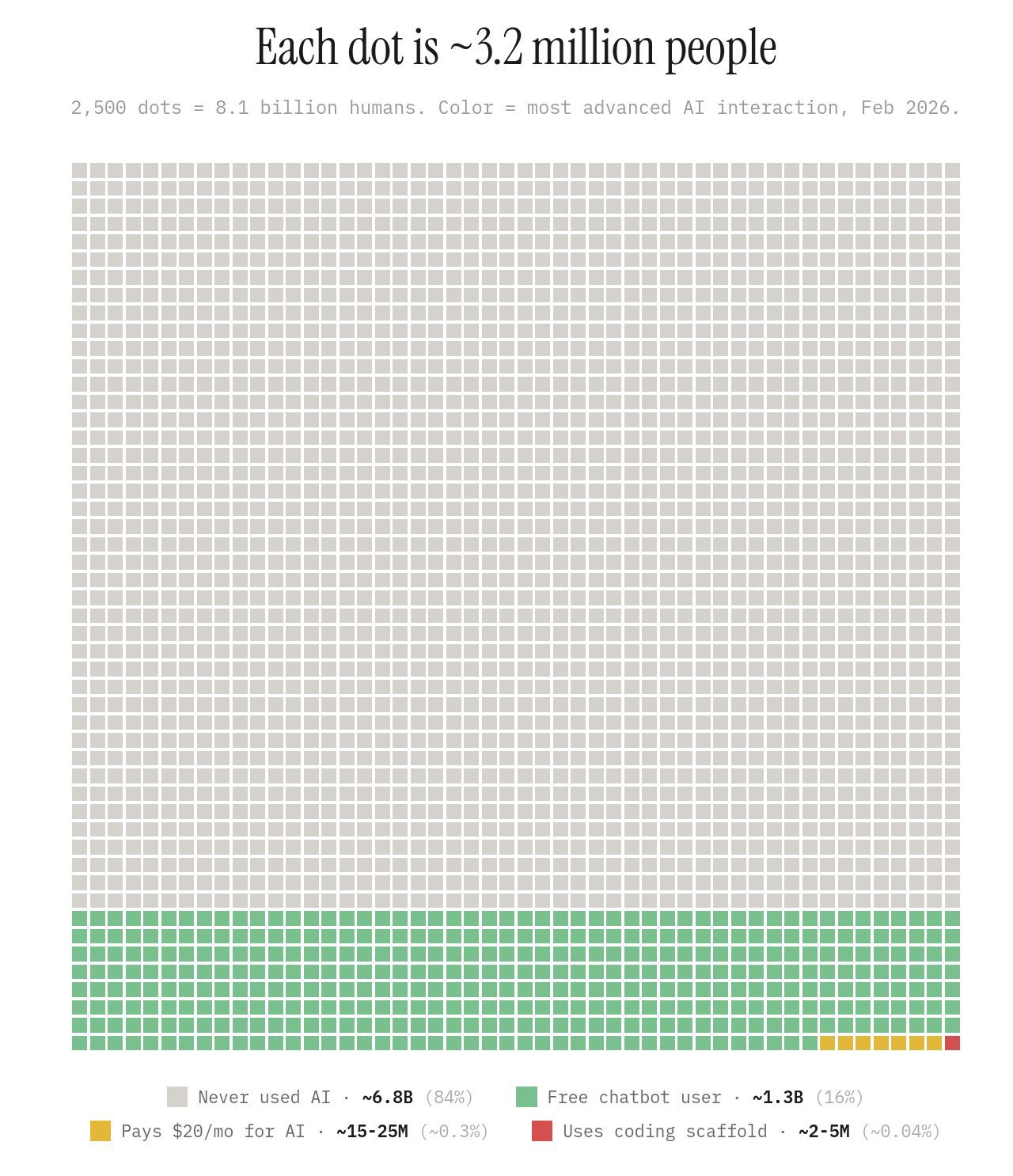
It shows staggering data on AI adoption which I think is interesting to consider in conjunction with the Citrini and Kobeissi posts this week.
Look how few people are paying to leverage AI outside of coding. $20 per month to unlock surges in efficiency and productivity. No complex tech background required.
It’s not only an indicator of how early we are but it also exposes another uncomfortable fact I talk about here quite often.
Humans hate paying for things. They want everything for free even when the benefits are obvious.
That mindset produces average outcomes. The people pulling ahead aren’t waiting to perfectly understand all of this madness they’re buying their seat early and sending it.
Crazy stuff.
Today’s guide is going to cover:
Is this piece from Citrini indicative of what is to come? Or is this a classic market overreaction? What about the response from The Kobeissi Letter?
How to think about this transition without getting blindsided
How Software/Tech/Bitcoin/ Cybersecurity and Crypto will continue to react to this (opportunities to watch)
Review of the best AI tools you should be using in February 2026
2026 has been wild so far. You can snap your neck trying to keep up with all of these updates that continue to influence markets and what people are expecting in the future.
The first major “breaking point” in the last several years was the normie vs. conspiracy Y in the road. You either escaping Plato’s cave or you continued to stare at the shadows on the wall, oblivious of what was actually taking place in the world.
I would argue this is a second major “breaking point”. Those who understand how the game of markets, finance, and the future of work are changing and those who do not.
The consequence for remaining ignorant in the first was just that, you were ignorant to how the world now operates.
The consequence for this second breaking point is much more dire. You either adapt to how markets, tech, and business are changing or there’s a good chance you fall behind and are unable to catch up.
Let’s get into it.
Here is the uncomfortable truth: AI is no longer just a tool for economic growth; it is a direct substitute for human cognitive labor. In the near term it will displace white collar workers faster than new markets can absorb them.
— Alap Shah
What’s Actually Going On
Let’s talk through a few major themes you need to keep an eye on so one day you don’t wake up and say “how the hell did that happen?”.